Antoni's Kalamata Concert
Cartes Postales from GreeceAntoni’s Kalamata concert turns an ordinary evening by the port into an unexpected public recital, and its effects reach beyond the music itself: the townspeople gather, Magda is visibly moved, and the violinist and his listener vanish before the evening is over. Recounted years later as a story by a kiosk owner, the performance becomes the measure against which Kalamata’s later street musicians are judged—and a memory whose ending remains strikingly open.
Arrival and Setting
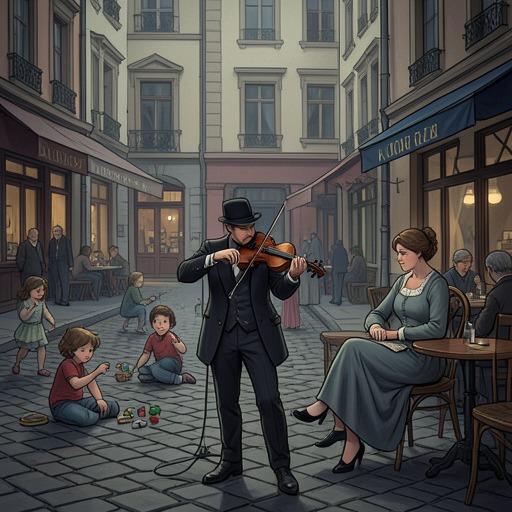
The story begins on an autumn day when Kalamata’s stationmaster, attentive to the arrival and departure of strangers, sees a man step down from the train from Corinth carrying a battered violin case. The newcomer’s radiant smile and sparkling eyes make him distinctive, but it is his appearance and music together that distinguish him from the itinerant bouzouki and klarino players who usually perform in town on feast days. He is dressed more smartly, and when he begins playing, the streets seem to acquire a different kind of sound. Children stop their games and gather around; when he finishes, one reaches up to touch the violin.
The concert’s decisive scene takes shape by the port. Magda is sitting outside a café owned by her cousin Andreas, smoking alone beside the still water and the deserted concrete expanse. In the distance, a few people wait to bring in and reload a boat. Warehouses hold crates of dried fruit ready for shipment and huge drums of olive oil. As the sky turns pink, a cyclist passes; then a sustained note breaks the quiet. Magda turns toward it and sees a handsome, middle-aged man playing the violin. He draws the bow steadily, then plays another note. Whether or not he is consciously playing for her, she feels addressed by the music.
A Waterfront Drawn into the Music
The performance alters the atmosphere around it. Magda closes her eyes and attends not only to the notes but to the spaces between them. Her response is involuntary and physical: the hairs on her arms rise, her throat tightens, and tears run down her cheeks. She reaches for paper napkins to dab at her face, but the tears continue, leaving a small mountain of crumpled napkins on the table. She is unsure whether she welcomes this reaction; she cannot make it stop.
The listening is not hers alone. People toss coins into the violin case as they pass, and the small contributions soon amount to the price of a meal. The money registers what the music has done to its listeners: they are not paying only for a performance, but responding to its effect on them. Against the sea’s stillness, even the violin’s whisper carries across the waterfront; when the music rises to a crescendo, its notes break through conversation. The scene’s transformation is collective as well as private. Where the port had been quiet, the music gives the gathering a shared focus, and Magda notices that others have been affected too.
As the evening advances, the crowd grows rather than disperses. By after ten, the cafés are full, more people keep arriving, and no seats are left. In a town where nothing is free, the impromptu recital has become an unprecedented gathering. At times the violin sounds so full and pure that its passages seem chorded, as though another, ghostly violin were playing nearby. The description preserves the listeners’ astonishment without turning the performance into a formal concert: people have come together around a stranger playing in the open air.
The Recital’s Close and Magda’s Disappearance
At about eleven thirty, the last note dies away. The audience answers with rapturous applause. Antoni places the violin in its case and loosens the tension in his bow, while the clapping continues. The only spare chair on the seafront is at Magda’s table, so he sits opposite her and smiles in acknowledgment of the crowd’s appreciation. Magda tells him the listeners loved him, though her own response is at the heart of what she says. He redirects the praise to the violin case and, by implication, to the music rather than to himself.
Later, Magda asks him to play the first tune again. Antoni agrees, and Bach’s “Air on a G String” sounds once more: sedate, unhurried, and powerful. The waterfront listens without stirring until the piece ends. As people rise to go home, they see Magda and the violinist sitting together, their heads close in conversation. The scene gives the public recital an intimate counterpoint: the music has gathered a crowd, but the final image narrows to the two people at the table.
When most of the tables are empty, Andreas comes out of the café carrying an industrial-sized olive tin. Its original contents are gone; it is filled to the top with coins left by customers for Antoni, heavy enough that Andreas struggles to lift it with both hands. Yet the musician is nowhere to be seen. Magda has disappeared as well, and the table where they had been sitting is empty. The story records their absence but does not explain it or establish what followed. The departure is therefore both the concert’s abrupt ending and the account’s unresolved turn.
A Memory That Outlasts the Night
The performance reaches the reader through a later conversation at a kiosk. A busker is singing nearby, but passers-by act as though he is not there, and nobody puts even ten cents into his open case. The kiosk owner’s regretful comparison makes Antoni the absent standard: after him, no one seems any good. He tells the tale as something remembered from a few years earlier, beginning it in the manner of a once-upon-a-time story. The narrator cannot tell how much the owner has embellished, but accepts the essential claim that a musician once came to Kalamata and left a lasting impression.
That frame gives the concert a second life. In the original scene, listeners gather and reward Antoni’s playing with their attention and coins; in the later scene, a different performer receives neither. The contrast makes the earlier audience’s response seem exceptional, while the full olive tin gives that response a concrete remnant. Antoni and Magda’s disappearance leaves the night without a confirmed explanation, but the music remains legible in what followed: in the town’s recollection, in the standard against which another musician is judged, and in the tune Magda hums the next day. Andreas recognizes it as the melody whose distinctive notes had lingered in his mind from the night before.